
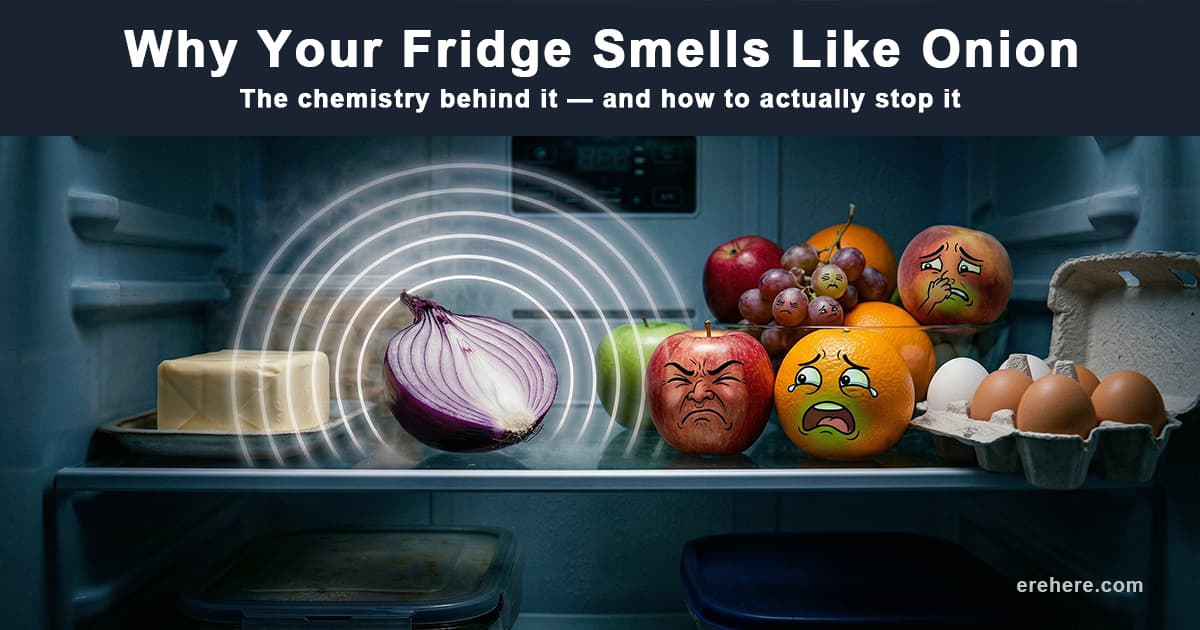
Quick Answer
Cut onions release volatile sulfur compounds small enough to pass through plastic wrap at the molecular level. They enter your refrigerator's circulating air and bind to every fat-containing food nearby. The only method that stops this is an airtight silicone container — one where the cut surface presses directly against the seal with no air gap remaining.
What a Cut Onion Actually Does to the Air Around It
An intact onion has almost no smell. The chemistry only starts when a knife breaks through the cell walls.
Inside each onion cell, two compounds stay separated by design: alliinase, an enzyme, and isoalliin, a sulfur-containing amino acid. The moment a cell ruptures, they mix. Within seconds, the reaction produces a cascade of volatile sulfur compounds — including syn-propanethial-S-oxide, which causes eye irritation, and a range of thiosulfinates responsible for the persistent sharp smell.
These molecules are small, light, and extremely volatile. They evaporate into surrounding air almost immediately. Once airborne inside a refrigerator, they don't stay in one place — they circulate with the air that the fridge continuously moves to maintain even temperature.
Fat absorbs volatile compounds faster than almost any other food component. This is why butter, soft cheese, and cream-based leftovers pick up onion smell within hours, while acidic foods like citrus resist it longer. This is not a wrapping problem. It's a physics problem.
Why Plastic Wrap Fails Every Time
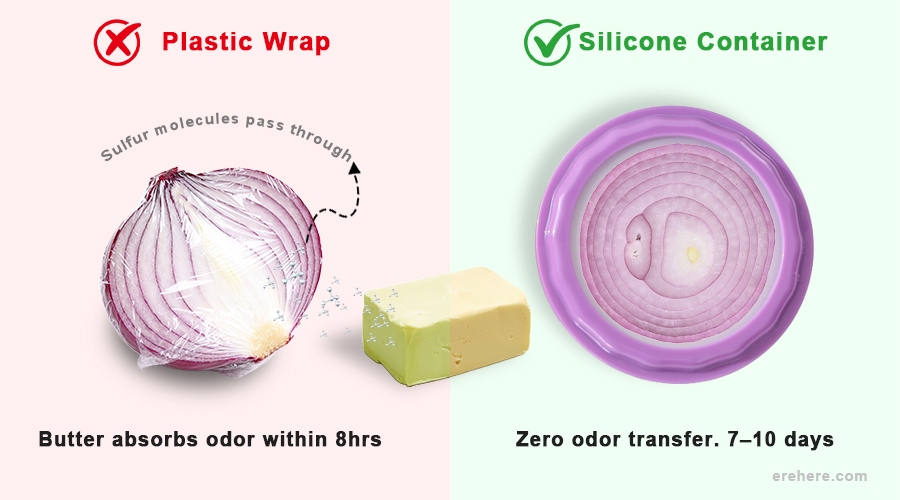
Low-density polyethylene — the material in most household plastic wraps — is a reasonable barrier against liquid and large particles. It is not a good barrier against small gas molecules.
Food packaging research has shown that volatile sulfur compounds, because of their small molecular size, exhibit measurable migration through LDPE film even at refrigerator temperatures. Wrapping tightly reduces the rate of escape by limiting exposed surface area. It does not eliminate migration — it slows it by a few hours.
Within 8 to 12 hours in a closed refrigerator, enough sulfur compounds have escaped through the wrap to noticeably contaminate surrounding food. By 24 hours, the effect is significant. By 48 hours, the entire fridge smells like onion regardless of how carefully it was wrapped.
Zip-lock bags perform somewhat better because the material is thicker. But the same molecular migration still occurs. Neither method was designed to contain gas molecules. That's the entire problem.
Why Your Refrigerator Makes It Worse
A refrigerator is a sealed, recirculating environment. The internal fan that maintains even temperature moves air continuously between compartments. Any volatile compound released by one food gets picked up by that circulating air and distributed to everything else.
Cold temperatures do slow the chemical reactions that produce sulfur compounds initially — which is why a cut onion lasts longer refrigerated than at room temperature. But cold does nothing to stop volatile compounds that have already entered the air from spreading. The refrigerator turns a manageable chemistry problem into a distribution problem.
The Storage Method That Actually Works
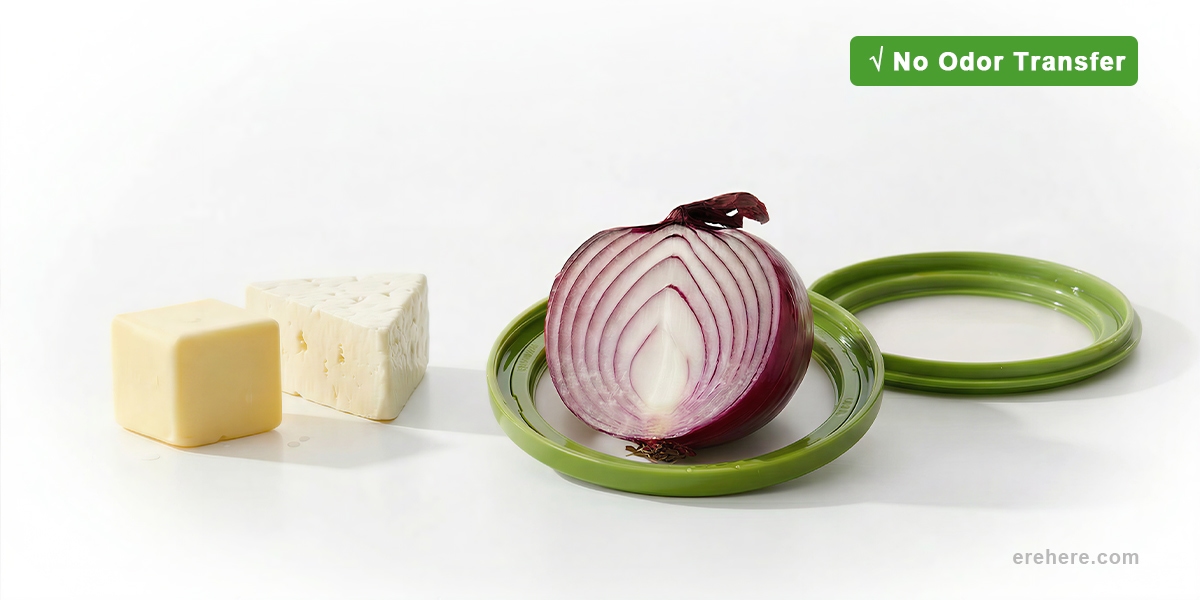
The only way to stop sulfur compounds from entering your refrigerator's air supply is to eliminate the air gap between the cut surface and the container entirely.
Silicone is non-porous. A food-grade silicone seal pressed directly against the cut face of an onion creates a contact barrier that volatile molecules cannot penetrate. Unlike rigid plastic lids — which trap a pocket of air between the lid and the onion surface — a silicone membrane conforms to the surface and leaves no air pocket at all.
The airtight onion keeper is built around this principle. The cut surface presses directly against the silicone film. Sulfur compounds have nowhere to go. In practice, a cut onion stays firm and fresh for 7 to 10 days — with no odor transfer to surrounding food.
Step 1 — Cut as close to use time as possible
Every minute a cut surface sits exposed increases the volume of sulfur already released. Contain the onion quickly after cutting, and there's less contamination to seal in.
Step 2 — Place cut-side down against the silicone
The cut surface needs full contact with the silicone membrane. Placing cut-side up — even inside an airtight container — leaves the most active surface facing trapped air. Cut-side down maximizes contact and minimizes interior air volume.
Step 3 — Refrigerate within 15 minutes of cutting
Room temperature significantly accelerates sulfur compound production. Even a sealed container will have more to contain if the onion sat out before going in.
...to keep it sealed properly. For exact timelines by cut type, see [how long a cut onion actually lasts].
Step 4 — Store away from high-fat foods as a secondary measure
A well-sealed container effectively eliminates odor transfer. As a backup, keeping it away from butter, soft cheese, and cream-based dishes adds a margin if seal contact is imperfect.
The most reliable fix is storing cut onions in a proper airtight container. See exactly how: how to store a cut onion without the smell spreading
How Long Does a Cut Onion Last? (By Storage Method)
| Storage Method | Shelf Life | Odor Transfer | Verdict |
|---|---|---|---|
| Uncovered at room temperature | 2–4 hours | Immediate and severe | Never |
| Plastic wrap, refrigerated | 3–5 days | Within 8–12 hours | Last resort only |
| Zip-lock bag, refrigerated | 5–7 days | Within 12–24 hours | Acceptable short-term |
| Hard container with snap lid | 5–7 days | Within 24–48 hours | Better, not ideal |
| Silicone airtight container | 7–10 days | Minimal to none | Best overall |
Other Foods That Do the Exact Same Thing
Onions are the most common refrigerator odor complaint, but the same mechanism applies to several other foods most people store the same way.
Garlic releases allicin and diallyl disulfide when cut. These compounds are more potent than most onion-derived sulfur molecules and bind even more aggressively to fats. A cut garlic clove in plastic wrap will contaminate butter faster than a cut onion will.
Fish produces trimethylamine during breakdown — the compound most people recognize as "fishy smell." It spreads rapidly in enclosed spaces and is notoriously resistant to elimination once absorbed into porous refrigerator surfaces.
Cruciferous vegetables — broccoli, cauliflower, cabbage, Brussels sprouts — produce sulfur compounds similar to onions when cut. A half-head of cabbage in plastic wrap will introduce detectable sulfur odor to a closed refrigerator within 24 hours.
Aged cheeses release volatile fatty acids during continued aging. In a confined space over several days, these noticeably affect the flavor of neutral foods stored nearby.
The solution is the same for all of them: a container that creates a genuine seal at the food's cut surface, not a loose barrier around it.
Does Baking Soda Actually Absorb Onion Smell?
Baking soda neutralizes odor compounds by reacting with acidic molecules and converting them into odorless salts. This works for some refrigerator odors, particularly those from spoiled acidic foods.
But do onions absorb smells, or are they mainly the source of them?
Sulfur compounds from cut onions are largely neutral to very mildly acidic. Baking soda has limited chemical reactivity with them — independent tests have found it reduces total odor concentration by roughly 10 to 20 percent over 24 hours. Meaningful for some smells, minor for onion sulfur specifically.
Baking soda is not a solution to onion smell. It's a partial mitigation for other things that accumulate over time. The onion problem requires containment at the source.
How to Remove Onion Smell That's Already in Your Fridge
If the smell has been in the refrigerator for 12 hours or more, the sulfur compounds have been absorbed into the refrigerator lining, door gaskets, and nearby packaging surfaces. Removing the onion stops new contamination — it doesn't clear what's already absorbed.
- Remove all food from the refrigerator.
- Wipe all interior surfaces with equal parts white vinegar and water. Vinegar is mildly acidic and partially neutralizes sulfur-based compounds on contact.
- Leave the refrigerator empty with the door slightly ajar for 30 to 60 minutes, allowing the interior to exchange air with the room.
- Place an open container of activated charcoal — not baking soda — inside for 24 hours. Activated charcoal physically adsorbs volatile molecules, including sulfur compounds, far more effectively than baking soda.
- Wipe down any food packaging that was inside during the contamination period before returning it.
Frequently Asked Questions
Why does my fridge smell like onion when I haven't cut one recently?
Whole onions release trace volatile compounds through their outer skin, especially if the skin is cracked or beginning to dry out. Storing whole onions outside the refrigerator — in a cool, dry, ventilated space — eliminates this entirely. Whole onions stored at room temperature also last longer than refrigerated ones, because cold and moisture accelerate softening.
Can onion smell transfer to sealed packaged food?
Yes, over time. Cardboard, paper, and thin plastic film are all permeable to volatile compounds with extended exposure. Sealed glass and metal cans are highly resistant. Cardboard-boxed items like crackers and cereal will absorb detectable onion odor within 48 to 72 hours of close proximity to an improperly stored cut onion.
Why does cooked onion smell so different from raw cut onion?
Heat transforms the volatile sulfur compounds responsible for the sharp smell into entirely different molecules — including disulfides and trisulfides that produce the sweeter, savory aroma of sautéed onion. These new compounds are less volatile and don't bind to surrounding food the way raw sulfur does. This is why caramelized onions stored in the refrigerator have almost no effect on nearby food, while raw cut onion contaminates everything within a day.
Does storing the cut surface in lemon juice help?
Citric acid from lemon juice reacts with some sulfur compounds and slightly reduces their volatility — but the effect is short-lived. Within a few hours in the refrigerator, the acid is neutralized and sulfur migration resumes. Lemon juice slows browning. It is not an effective odor containment method.
Is it safe to eat a cut onion that's been in the fridge for a week?
Generally yes, if it was stored properly from the start — refrigerated within 30 minutes of cutting, kept at or below 40°F (4°C), and sealed. Signs it's no longer safe: visible mold, significant sliminess, or a smell that has shifted from sharp-sulfurous to rotten or fermented. A well-stored cut onion is safe at 7 days; one left at warm temperatures or improperly sealed may not be at 3.
Why does my fridge still smell like onion after I threw the onion away?
Because the compounds have already been absorbed into the refrigerator lining, gaskets, and nearby packaging surfaces. Removing the source stops new contamination — it doesn't reverse what's already been absorbed. Follow the removal steps above to actively clear what's there.
The Bottom Line
Your refrigerator smells like onion because cut onions release sulfur compounds small enough to pass through plastic wrap at the molecular level. Those compounds enter your refrigerator's circulating air and bind to every fat-containing food in range. The wrapping method matters — but only within a narrow range. Even the best-sealed plastic wrap will allow detectable contamination within 24 hours. The chemistry does not care how tightly you wrapped it.
The only effective solution is a container that eliminates the air gap between the cut surface and the seal entirely. The Erehere produce keeper set includes a dedicated onion container built around a food-grade silicone seal — along with matching keepers for avocado, tomato, and lemon.
Once you make that switch, the onion smell stops. And everything else in your fridge goes back to tasting like itself.
More from the Erehere kitchen:

