
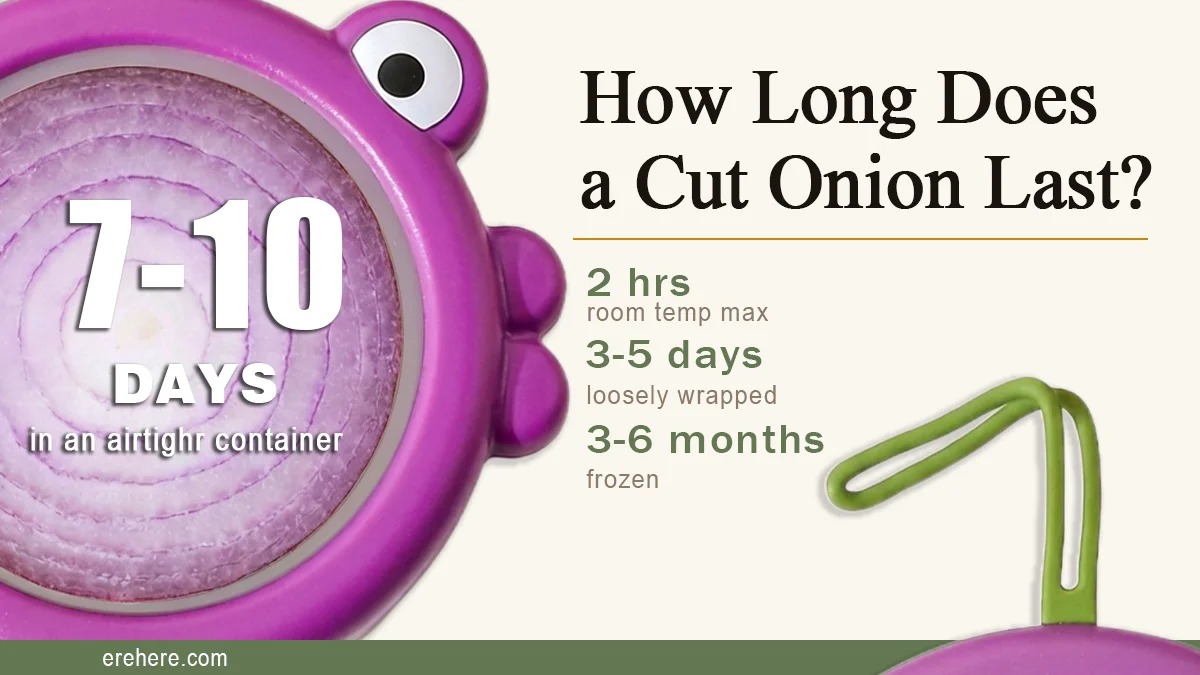
You cut an onion for dinner, used half, and now the other half is sitting in your fridge. How long is it actually good for — and how do you know when it's crossed the line? The answer isn't one number. It changes based on how you cut it, how you store it, and what kind of onion it is. Here's everything laid out clearly.
Already know the storage methods? This guide focuses on what happens after you store it — specifically, how many days each method actually buys you, how cut type changes that timeline, and how to make the call when you're not sure if it's still good.
⚡ Quick Answer
- Room temperature: 2 hours max (USDA food safety limit)
- Fridge — loosely wrapped: 3–5 days
- Fridge — airtight container: 7–10 days (USDA)
- Freezer — diced or sliced: 3–6 months
By Storage Method: The Full Breakdown
Most articles give you one number. The reality is that storage method makes a 2× to 3× difference in how long your cut onion stays usable.
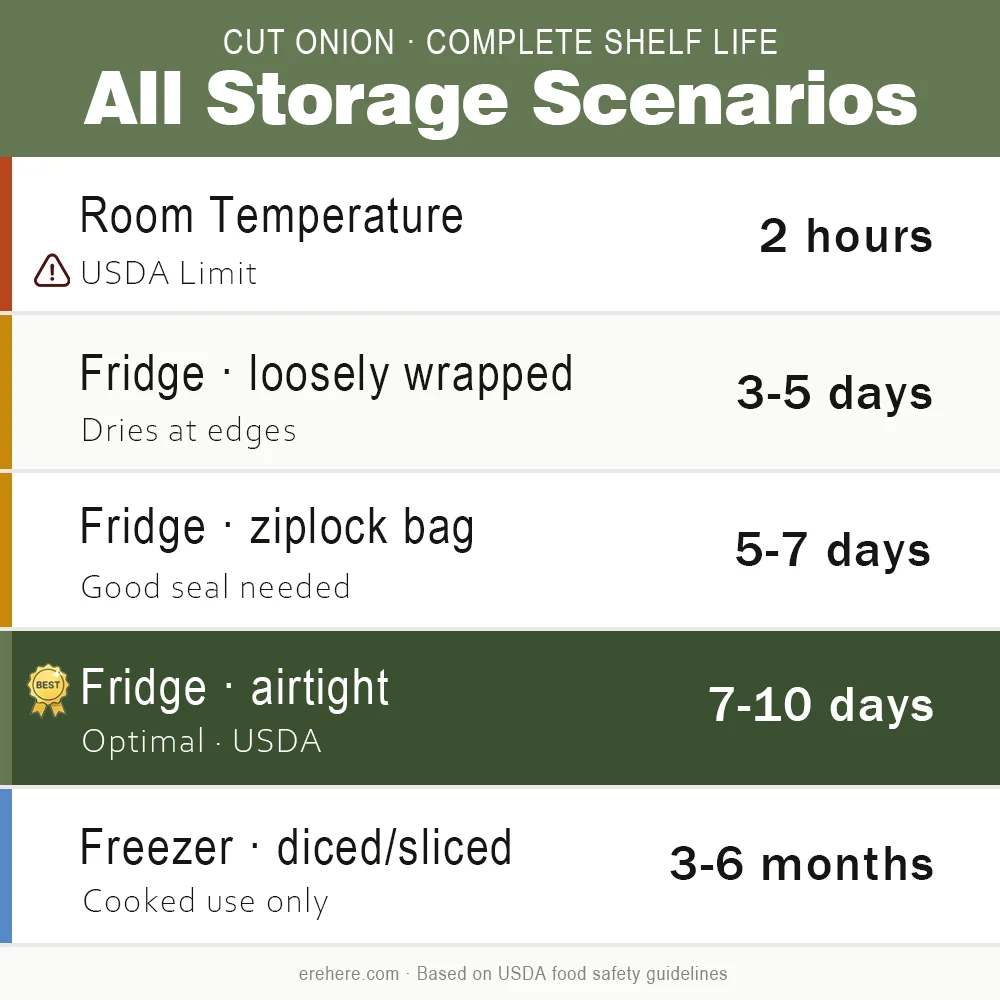
| Storage Method | How Long It Lasts | Quality Kept | Smell Risk | Verdict |
|---|---|---|---|---|
| Room temperature, uncovered | 2 hours | ⚠️ Safety risk after 2h | High | 🚫 Don't |
| Fridge, plastic wrap only | 3–5 days | Dries out edges | Medium — escapes wrap | 🟡 OK short-term |
| Fridge, ziplock bag | 5–7 days | Good if sealed tight | Low if fully sealed | ✅ Decent |
| Fridge, airtight container | 7–10 days | Best — minimal moisture loss | Very low | ✅ Best |
| Freezer, diced/sliced | 3–6 months | Soft after thaw — cooked use only | None | ✅ For cooking |
The USDA and National Onion Association both cite 7–10 days as the standard for properly sealed cut onions refrigerated at or below 40°F. The lower end of that range (3–5 days) is what you get when the seal isn't tight.
Why Room Temperature Is Riskier Than You Think
You probably know cut onions shouldn't sit out too long — but most people don't know exactly why, or where the actual safety line is.
The USDA's food safety guidelines establish a "danger zone" between 40°F and 140°F (4°C–60°C). In this temperature range, bacteria can double roughly every 20 minutes. A cut onion left on the counter at room temperature (typically 68–72°F) sits squarely in that zone.
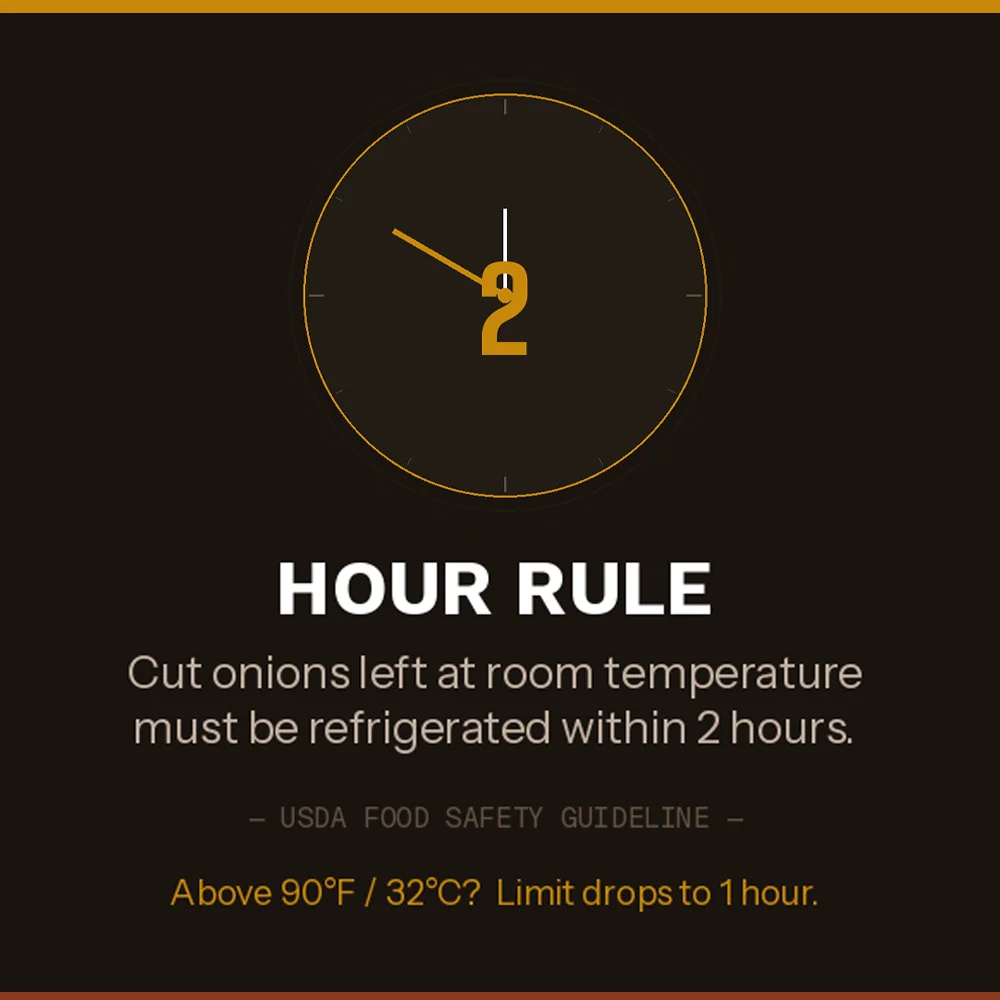
⚠️ The 2-Hour Rule
Any cut produce — including onions — left at room temperature for more than 2 hours should be refrigerated or discarded. In hot conditions above 90°F (like a summer kitchen), that window shrinks to 1 hour.
This isn't about smell or appearance. Bacterial growth at this stage is invisible. The onion can look and smell fine and still be in the danger zone.
In practice: if you cut an onion while prepping dinner and the other half sits next to the stove for two hours while you cook, eat, and clean up — refrigerate it the moment you think of it. If it's been more than two hours and you're not sure, err on the side of tossing it.
Does the Cut Matter? Half vs. Sliced vs. Diced
This is where most storage guides go wrong: they treat all cut onions as one thing. But a half onion and a bowl of diced onion have completely different storage timelines.
The reason comes down to surface area. The more surface area exposed to air, the faster oxidation and moisture loss happen — and the faster quality degrades.
Half Onion
7–10 days in airtight container
Only one flat cut surface exposed. Store cut-side down in an airtight keeper to minimize air contact. This is the most forgiving cut to store — the papery outer layers on the curved side act as a natural barrier.
💡 Best method: airtight container or airtight onion keeper designed to fit the cut side flush.
Sliced Onion
5–7 days in airtight container
Each ring has two cut surfaces. More total area exposed means faster drying and flavor loss. Rings also tend to absorb fridge odors more readily. Keep in a sealed container — not just loosely covered with plastic wrap.
💡 Best method: airtight container, ideally with a flat lid pressed close to the slices.
Diced Onion
3–5 days in airtight container
Dozens of small pieces, each with multiple cut faces. The maximum surface-area scenario. Diced onions dry out fastest, lose their sharp bite soonest, and also release the most sulfur compounds into the rest of your fridge. Use within 3–5 days for best flavor.
💡 Best method: small airtight container filled close to the top (less air inside = slower degradation).
Red vs. Yellow vs. White — Do They Last the Same?
Not quite. The variety affects both shelf life and what happens to flavor and texture over time.
🟡 Yellow Onion
Fridge shelf life: 7–10 days (half), 5–7 days (sliced/diced)
The most common grocery store onion. Higher pyruvic acid content means stronger flavor that holds up well in storage. The most forgiving variety — flavor doesn't change dramatically over the first week.
🔴 Red Onion
Fridge shelf life: 7–10 days (half), 5–7 days (sliced/diced)
Red onions contain anthocyanins — the same antioxidant pigments that give berries their color. These provide mild antimicrobial properties that help red onions resist spoilage slightly longer. The color also makes it easy to spot spoilage (browning is more obvious against the purple skin).
⚪ White Onion
Fridge shelf life: 5–7 days (half), 3–5 days (sliced/diced)
Higher water content and milder flavor means white onions degrade faster than yellow or red. They're also more prone to developing a slimy texture as they age. Use white onions within 5 days of cutting for best results.
🍯 Sweet Onion (Vidalia, Walla Walla)
Fridge shelf life: 4–6 days (half), 3–4 days (sliced/diced)
Sweet onions are best thought of as a perishable ingredient, not a pantry staple. Their high moisture and low sulfur content — the very things that make them mild and pleasant raw — make them the fastest to deteriorate once cut. If you've bought a Vidalia specifically for a salad or fresh topping, use it that day or the next. What's left by day 4 is best headed into a soup or pan, not back onto the cutting board.
💡 A useful shortcut: The onions that make you cry the most (yellow, red) outlast the ones that don't (sweet, white) once cut. Tear-inducing sulfur compounds act as natural preservatives — the tradeoff for a more forgiving fridge life.
How to Tell If Your Cut Onion Has Gone Bad
Here's the mistake most people make: they throw out a cut onion because the flat surface turned brown. That browning is just oxidation — the same chemistry that turns a sliced apple or avocado brown when it meets air. It tells you the onion has been exposed to oxygen, not that it's spoiled. The cut surface can be noticeably brown and the onion is still perfectly fine to cook with.
What you're actually looking for is breakdown, not color change. These are different things:
✅ Oxidation — Still Good
- Flat cut surface turned brown or beige
- Dry or slightly papery at the cut edge
- Smell is sharp — normal onion pungency
- Layers feel firm when pressed
- Within the expected storage window
Slice off the browned layer (2–3mm) and use the rest normally. The onion underneath is fine.
⚠️ Borderline — Use Judgment
- Browning goes deeper than the surface layer
- Smell has shifted — sharper or slightly off
- Texture is soft but not wet or slimy
- Past day 7, even if stored properly
Smell is the most reliable indicator here. Pungent-but-still-onion = probably fine for cooking. Sour or fermented note = discard.
🚫 Breakdown — Discard
- Wet, translucent, or slimy surface film
- Smell is sour, fermented, or rotten — clearly wrong
- Visible fuzzy mold on any surface
- Layers feel waterlogged or collapse under pressure
- Deep discoloration through multiple layers
Don't try to salvage it by cutting around the bad spots. Bacterial breakdown at this stage has spread through the cell structure — discard the whole piece.
💡 The one-question test: Does it smell like onion, or does it smell like something going wrong? If you have to ask the second question, you have your answer.
How to Make a Cut Onion Last Longer
The mechanics are simple: limit air exposure and keep temperature consistently low. Here's what actually moves the needle.
Plastic wrap compresses against the cut face but rarely creates a true seal — air still gets in at the edges. A lidded container eliminates that gap. An airtight onion keeper that fits the shape of a half onion takes this further by pressing a silicone seal directly against the cut surface.
For a half onion, placing it cut-face down in the container minimizes the cut surface's contact with air. The curved papery side faces up, acting as a natural shield.
Fridge door temperature fluctuates every time you open it. The back of the fridge maintains the steadiest cold — which slows bacterial growth and preserves texture longest.
Adding water speeds up moisture loss and mold growth during storage. Store it dry. If you want to rinse, do it right before using.
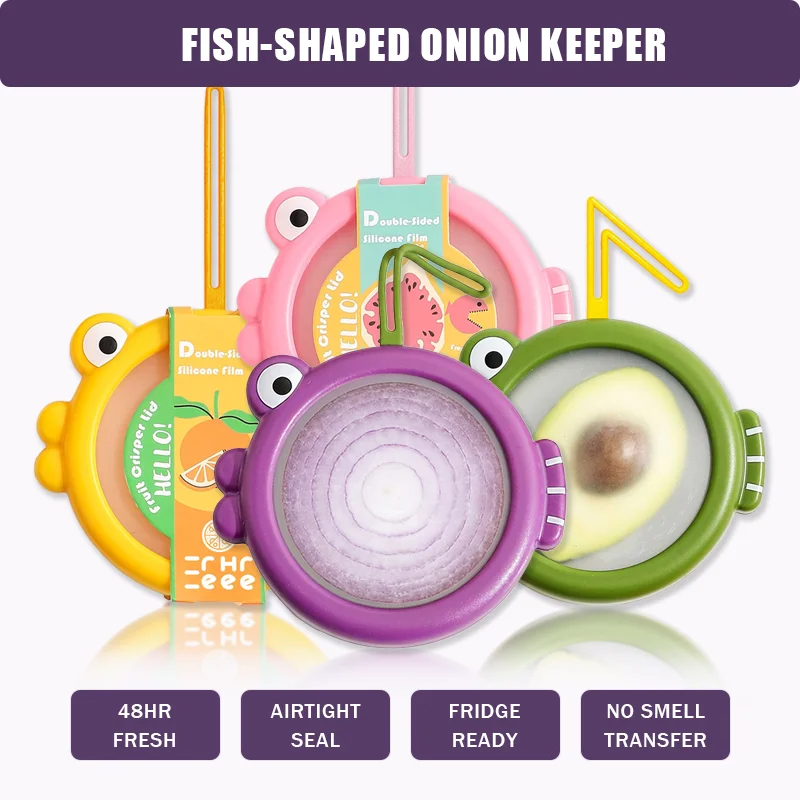
For the best setup, we designed the Fish-Shaped Avocado & Onion Keeper to solve this specific problem. The silicone seal fits snugly against the cut face of a half onion (and a half avocado), keeping the interior almost entirely air-free. It also keeps onion smell from escaping into the rest of the fridge — which is its own quality-of-life upgrade.
For more detailed storage methods, see our full guide: How to Store a Cut Onion — 4 Methods Tested.
Can You Freeze a Cut Onion?
Yes — and it's more useful than most people realize. Frozen onion skips the tears when you chop it later (freezing breaks down the cells that release the tear-inducing compounds), and it keeps for months.
How to Freeze Cut Onion (3 Steps)
- Chop or slice first. Freezing a half onion whole works, but the texture suffers more. Dice or slice into your preferred size before freezing — you'll thank yourself later.
- Spread on a baking sheet and pre-freeze for 1 hour. This prevents the pieces from clumping into a solid block. Once frozen individually, transfer to a freezer-safe bag or container.
- Label with the date and use within 3–6 months. Quality holds best in the first 3 months. After 6 months, texture and flavor start to degrade noticeably.
⚠️ Important: Frozen onions become soft after thawing due to ice crystal damage to cell walls. They work beautifully in soups, stews, sautés, and sauces — but not in dishes where you want firm, crisp onion texture (like salads or fresh salsas).
Frequently Asked Questions
How long does a cut onion last in the fridge?
According to the USDA, cut onions stored in a sealed airtight container at 40°F or below last 7 to 10 days. Without a proper seal, expect 3 to 5 days before quality drops. The type of cut matters too: a half onion hits the 10-day end of the range; diced onion is closer to 3–5 days even with a tight seal.
How long do cut onions last at room temperature?
The USDA recommends no more than 2 hours at room temperature (1 hour if it's above 90°F). After that, harmful bacteria can multiply to unsafe levels — even if the onion looks and smells fine. When in doubt, refrigerate it.
Is it safe to eat a cut onion that's been in the fridge for a week?
If it was stored in an airtight container and your fridge runs at or below 40°F, a properly sealed cut onion at 7 days is within the USDA's safe range. Do the three-step check: look (no sliminess or mold), smell (sharp onion smell, not sour or fermented), touch (firm, not mushy). If it passes all three, it's safe. If anything seems off, discard it.
Why does my fridge smell like onion after storing a cut onion?
Onions release sulfur compounds even when stored — and if the container isn't truly airtight, those compounds escape into the fridge air and get absorbed by other foods. An airtight seal (not just plastic wrap) solves this. If your fridge already smells of onion, see our guide: Why Does My Fridge Smell Like Onion?
Can I store a cut onion in the same container as other vegetables?
Not recommended. Onions transfer their sulfur-based aroma compounds readily — store them with apples or potatoes and you'll notice both the smell and flavor transfer. Keep cut onions in their own dedicated sealed container.
Stop Losing Half an Onion Every Week
The Fish-Shaped Avocado & Onion Keeper creates an airtight silicone seal directly against the cut face of your onion — no plastic wrap gaps, no fridge odor escape. BPA-free, dishwasher safe, and it works for avocado halves too.
Shop the Onion Keeper →🚀 Ships from US · 30-Day Money-Back Guarantee · 🌊 Every order removes 1 lb ocean plastic

