
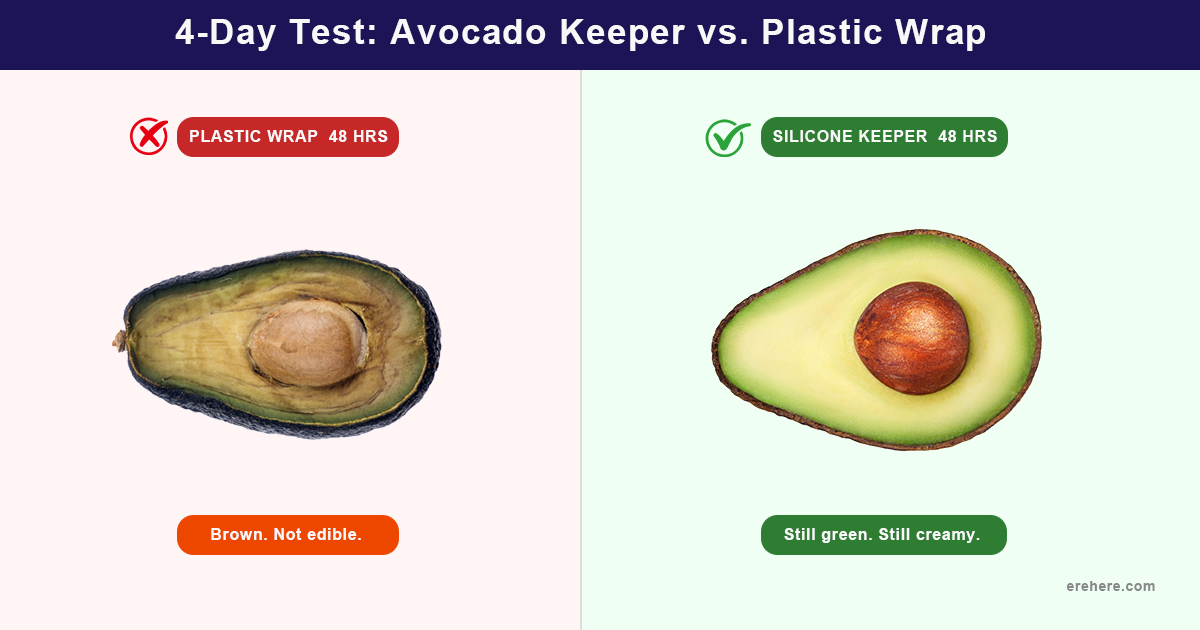
Plastic wrap is what most of us reach for. It's already in the drawer, it takes three seconds, and it feels like it should work. You press it against the cut surface, smooth out the air pockets, and put the avocado in the fridge with reasonable confidence.
The next morning, you peel back the wrap and find the top layer has turned gray-brown. You scrape it off, tell yourself it's fine, and eat what's underneath.
This happens almost every time. And most people assume it's just how avocados work — that browning is inevitable, that nothing really keeps them green.
It isn't. We tested both methods side by side for four days to show exactly what the difference looks like, and why it's not close.
Quick Answer
After 48 hours in the fridge, avocado stored in plastic wrap showed significant browning across the entire cut surface. Avocado stored in an airtight silicone keeper was still green and creamy with no texture change. At 96 hours, the plastic wrap avocado was past usable. The silicone keeper avocado was still edible. The difference comes down to one thing: whether the method actually eliminates air contact or just reduces it.
Why Avocado Browns — And What Actually Stops It
Browning in cut avocado is caused by oxidation. When you cut into an avocado, you rupture cells that contain an enzyme called polyphenol oxidase. That enzyme reacts with oxygen in the surrounding air and produces melanin — the brown pigment you see on the surface.
The reaction is fast. At room temperature, visible browning starts within 30 minutes of cutting. In the refrigerator, the cold slows the enzyme activity, which is why refrigerated avocado stays usable longer than one left out on the counter. But cold alone doesn't stop the reaction. It only slows it.
The only way to stop browning is to eliminate the oxygen. Not reduce it. Eliminate it. Any method that leaves even a small air gap between the avocado surface and the storage barrier will allow continued oxidation — it just happens more slowly.
This is where plastic wrap fails, and where it fails consistently.
The Problem With Plastic Wrap
Plastic wrap seems like it should work. You press it directly against the surface, smooth it down, and it creates what looks like contact. The problem is that the surface of a cut avocado is not flat. It has natural contours, the indentation where the pit was, and slight surface irregularities. Press plastic wrap against it and you will always leave small pockets of trapped air somewhere.
Those air pockets are where oxidation continues throughout the night.
There's a second problem that most guides don't mention. Even when plastic wrap achieves good contact, it is permeable to gas molecules. Low-density polyethylene — the material in most household cling wraps — allows oxygen to migrate through the material itself over time. Not through gaps. Through the wrap. This is the same property that makes plastic wrap fail to contain onion odor, and it applies to oxygen as well over extended storage periods.
For short storage of a few hours, plastic wrap is adequate. For overnight or longer, the limitations become visible.
The Test: 4 Days, Side by Side
We cut one avocado in half, removed the pit from both halves, and stored each using a different method. Both halves came from the same avocado, cut at the same time, and stored in the same refrigerator at the same temperature. We photographed and assessed each half at 8 hours, 24 hours, 48 hours, and 96 hours.
| Time Point | Plastic Wrap | Silicone Keeper |
|---|---|---|
| 8 hours | Light browning at edges and around pit area. Surface slightly dull. | Fully green. No color change. Texture unchanged. |
| 24 hours | Moderate browning across most of the cut surface. A thin layer needs scraping before eating. | Green. Slight surface moisture from condensation. Still creamy and intact underneath. |
| 48 hours | Significant browning. Gray-brown layer 2–3mm deep. Texture beginning to soften unevenly. Edible with scraping but not appealing. | Still green across the entire surface. Creamy texture maintained. No scraping required. |
| 96 hours | Brown throughout much of the surface layer. Mushy in spots. Most people would discard this half. | Light browning beginning at edges only. Center still green and usable. Texture slightly softer but intact. |
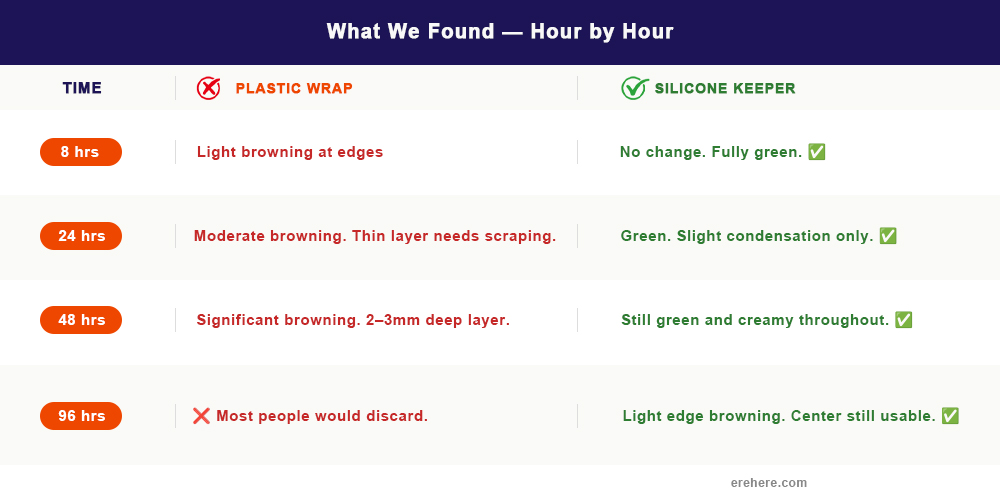
The difference at 48 hours is the most relevant data point for most people. That's the gap between cutting an avocado on Sunday and eating it on Tuesday morning. With plastic wrap, you're scraping. With a silicone keeper, you're not.
Why the Silicone Keeper Works When Plastic Wrap Doesn't
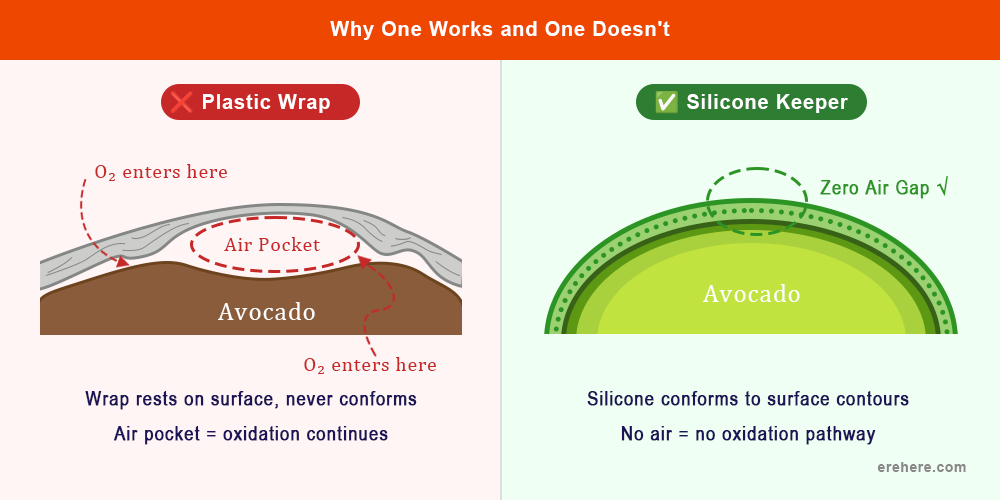
The key difference is how each method creates its seal.
Plastic wrap creates a barrier by lying against the surface. Any point where contact isn't perfect — the curve of the avocado, the dip where the pit was, the natural unevenness of cut produce — becomes an air pocket. The wrap also has gas permeability over extended periods, which matters less over a few hours but increasingly matters over 24 to 48 hours.
A silicone keeper works differently. The flexible silicone membrane conforms to the surface of the avocado rather than resting against it. When you place the avocado cut-side down against the silicone, the membrane presses upward and fills the contours — including the pit cavity — reducing or eliminating the air gap entirely. There is no permeability issue because silicone is non-porous to oxygen at refrigerator temperatures.
The Erehere produce keeper set uses this contact-seal design. The avocado goes cut-side down, the silicone presses against the surface, and the oxygen pathway closes. This is why the results at 48 hours look the way they do.
What About Lemon Juice?
Lemon juice works by introducing citric acid to the cut surface. Acid inhibits the polyphenol oxidase enzyme that drives browning — it slows the reaction rather than stopping it. The practical result: the avocado browns noticeably more slowly than it would uncovered, but still browns.
Lemon juice combined with plastic wrap performs better than plastic wrap alone. At 24 hours, the browning is lighter. At 48 hours, you still need to scrape.
Two problems with relying on lemon juice: First, it changes the flavor of the avocado. By day two, the lemon comes through noticeably, especially in applications where you want clean avocado flavor — sliced on toast, in a salad, as a topping. Second, it introduces moisture to the surface, which can lead to a slightly slimy texture as storage extends.
Lemon juice is a useful backup when you don't have a keeper available. It is not a replacement for eliminating oxygen contact.
What About the Pit Trick?
Leaving the pit in the avocado half is one of the most widely repeated storage tips. The logic is that the pit protects the flesh underneath it from browning.
This is partially true. The surface directly beneath the pit stays greener longer because the pit physically blocks oxygen from reaching that spot. But the pit covers roughly 10 to 15 percent of the cut surface on a typical avocado half. The other 85 to 90 percent is fully exposed and browns normally.
In practice, an avocado stored with the pit but without additional coverage browns across most of its surface within 24 hours. The small green circle under where the pit sat provides essentially no meaningful benefit for the overall half.
What Else Can the Keeper Store?
Most avocado storage guides cover avocado. They don't mention that the silicone keeper also solves a second problem that affects everything else in your fridge.
Cut onions release volatile sulfur compounds that pass through plastic wrap at a molecular level. Once in your refrigerator's circulating air, those compounds absorb into nearby foods — including your carefully stored avocado. An avocado stored in plastic wrap near a plastic-wrapped onion will absorb onion flavor within 24 hours.
An airtight silicone keeper on the onion side contains the sulfur completely. An airtight silicone keeper on the avocado side protects the avocado from whatever else is in the fridge. A 4-piece set that covers both solves the problem from both directions simultaneously.
This is the practical case for a dedicated produce keeper set rather than individual solutions. The avocado keeper and the onion keeper work together — one protecting your avocado from browning, the other protecting everything else in your fridge from onion contamination.
Is a Silicone Keeper Worth It?
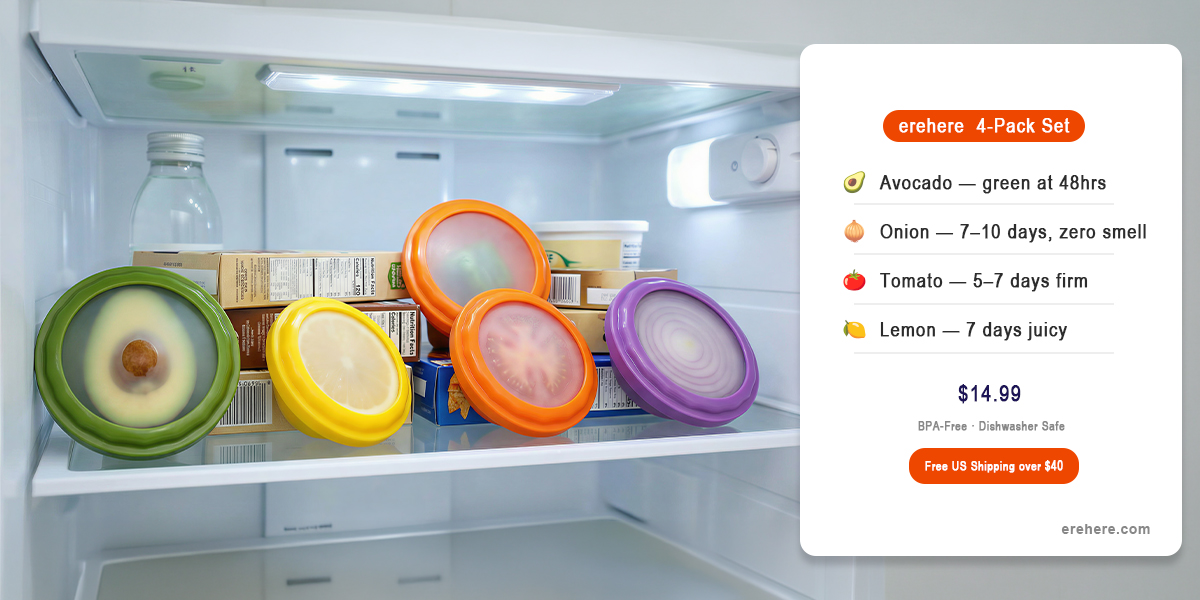
A set of four produce keepers — avocado, onion, tomato, lemon — costs $14.99. One avocado at a grocery store costs $1.00 to $2.00 depending on where you shop and the time of year. If you cut and store one avocado per week, and save even half of the halves you would otherwise discard, you recover the cost of the keepers in under three months.
The case is stronger when you account for the onion keeper. If you cook with onions regularly, you are probably discarding a portion of every onion you cut, or losing flavor from nearby food to onion contamination. The keeper addresses both.
None of this requires doing math at the grocery store. The question is simply whether you want the avocado you put in the fridge on Sunday to still be worth eating on Tuesday. The test results above show what each method delivers.
Frequently Asked Questions
How long does avocado last in a silicone keeper?
In our testing, avocado stored cut-side down in an airtight silicone keeper remained green and creamy for 48 hours with no browning, and was still usable at 96 hours with only light browning at the edges. Results vary depending on the ripeness of the avocado when stored — a fully ripe avocado at the time of cutting will brown faster at every stage than one that was slightly underripe.
Does the silicone keeper work with or without the pit?
It works with both. The flexible silicone membrane conforms to the pit cavity when the pit is in, and fills the space when it's out. Removing the pit creates a flatter cut surface that actually makes better contact with the silicone, so the seal may be slightly more complete without the pit. Either way it works.
Can I store guacamole in the same container?
Yes, with a slight adjustment. Fill the container and press the guacamole toward the center, mounding it slightly so the lid presses the surface flat when closed. The goal is to minimize the air pocket between the surface of the guac and the silicone. Guacamole stored this way lasts 2 to 3 days before significant browning — considerably longer than in a regular container with a gap at the top.
What's the difference between a silicone keeper and a hard-sided avocado container?
Hard-sided containers protect the avocado from physical damage (useful in a packed fridge) but their rigid lids can't conform to the cut surface. They trap air inside rather than eliminating it. The silicone membrane in a flexible keeper creates surface contact that a snap lid cannot. Both are better than plastic wrap; the silicone keeper is better at limiting oxidation.
Does the keeper eliminate browning completely?
Not completely. No storage method stops oxidation permanently — refrigeration slows it, and an airtight seal slows it further, but the reaction continues at a reduced rate. What the keeper eliminates is the visible browning that happens overnight and makes the avocado look unappealing before it actually spoils. The goal is not a perfectly preserved avocado indefinitely. It is an avocado that still looks and tastes good when you reach for it two days later.
The Bottom Line
Plastic wrap reduces air exposure. It does not eliminate it. The air pockets that form against the curved surface of a cut avocado — and the slow gas permeability of the wrap material itself over longer storage — mean that browning continues overnight and accelerates past 24 hours.
An airtight silicone keeper eliminates the air gap by conforming to the surface. The difference in results at 48 hours is visible and significant. The avocado you put in the fridge Sunday night is still worth eating Tuesday morning.
If you cut avocados more than once a week, the math on a silicone keeper works out quickly. The Erehere 4-pack set covers avocado, onion, tomato, and lemon — the four cut produce items most likely to go to waste in a typical household — for $14.99.
There is no trick that makes plastic wrap work as well as eliminating the air. The test results show what each method actually delivers.
More from the Erehere kitchen:

