
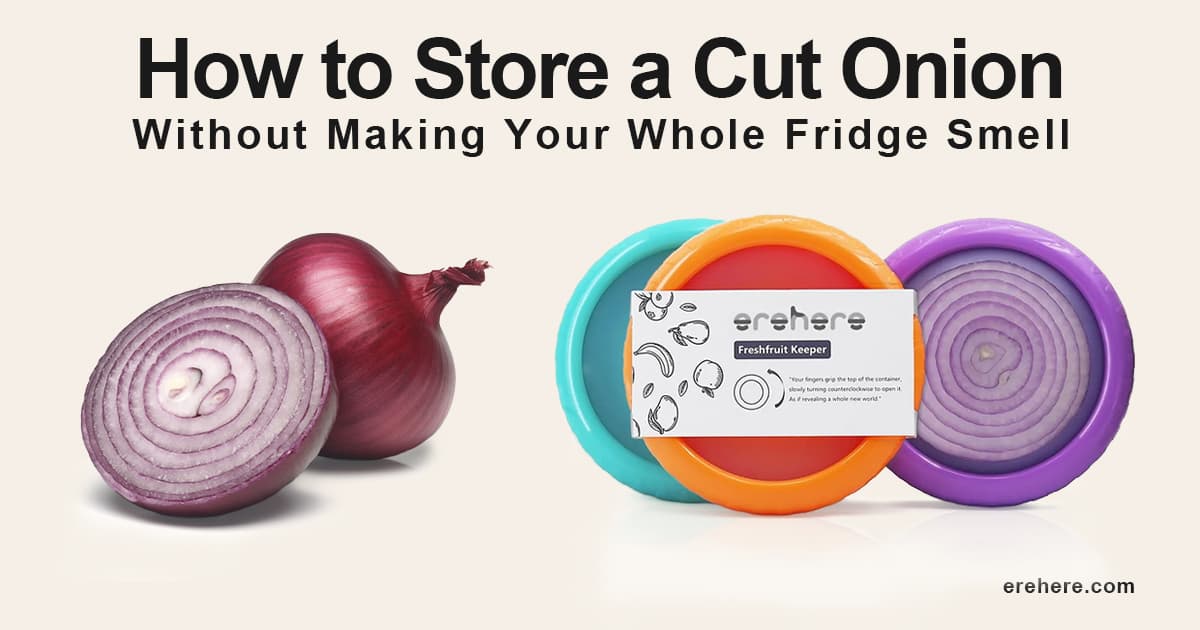
Quick Answer
The best way to store a cut onion is cut-side down in an airtight silicone container, refrigerated within 15 minutes of cutting. Stored this way, a cut onion stays firm and fresh for 7 to 10 days with zero odor transfer to other food. Plastic wrap allows sulfur compounds to escape within hours — which is why your fridge ends up smelling like onion even when the onion is "wrapped."
You cut half an onion for dinner. You wrap the other half in plastic wrap, stick it in the fridge, and think nothing of it.
By morning, your fridge smells like a deli counter.
The plastic wrap didn't fail because you did something wrong. It failed because plastic wrap is physically incapable of containing the sulfur compounds that cut onions release. Those molecules are small enough to pass straight through the wrap — and they will coat everything near them, from your butter to your leftover pasta.
This guide covers every storage method that actually gets used, why most of them fall short, and what the science says about keeping cut onions genuinely fresh without fumigating your entire refrigerator.
Why a Cut Onion Makes the Whole Fridge Smell
When you cut into an onion, you rupture its cell walls. That rupture triggers a chain reaction: an enzyme called alliinase comes into contact with sulfur-containing compounds that were previously stored separately inside the onion's cells. The reaction produces thiosulfinates and other volatile sulfur compounds — the same chemistry responsible for making your eyes water at the cutting board.
Those compounds don't stay in the onion. They off-gas continuously from any exposed cut surface, and they're small enough to permeate plastic wrap, foil, and loosely sealed containers. Once they're in the air inside your fridge, they absorb into soft foods — butter, cheese, open fruit, anything porous.
The only way to stop them is a seal that physically traps them inside the container. That's what determines whether a storage method actually works, or just slows things down slightly before the smell takes over.
Wondering why your fridge smells even after you remove the onion — or why wrapping it never works? We broke down the full chemistry behind it here: Why Does My Fridge Smell Like Onion? (It's Not the Onion's Fault)
4 Common Methods for Storing Cut Onion — Tested
Most kitchens use one of four approaches. Here's what actually happens with each one.
1. Plastic Wrap
The most common method and, unfortunately, the least effective at odor control. Plastic wrap creates a physical barrier that slows moisture loss, which is why wrapped onions don't dry out as fast as uncovered ones. But sulfur molecules are small enough to pass through the wrap's molecular structure, and the seal at the edges is almost never fully airtight.
A plastic-wrapped half onion typically lasts 2 to 3 days before the exposed surface starts to dry and toughen. Your fridge will smell like onion within a few hours of putting it in.
Use this only if it's your only option and you plan to use the onion the same day or next morning.
2. Zip-Lock Bag
Better than plastic wrap because you can press out most of the air before sealing, which slows oxidation at the cut surface. A zip-lock bag will keep a cut onion usable for 4 to 7 days depending on how well you squeeze out the air and how tightly the zip seals.
The problem: zip-lock bags are not airtight. The zip closure leaks. Press your ear against a sealed bag and squeeze — you'll hear air escaping. That same gap lets sulfur compounds out. Your fridge will still smell, just not as quickly.
Better for diced onion stored short-term than for a half onion you want to keep for a week.
3. Glass or Hard-Sided Container with a Snap Lid
A meaningful improvement over the two options above. Hard-sided containers protect the onion's shape, and a snap lid creates a better seal than plastic wrap or a zip-lock. A cut onion stored this way will stay firm for 5 to 7 days.
The limitation is the lid seal. Standard Tupperware-style snap lids are designed to be food-safe and moderately airtight, not hermetically sealed. Sulfur compounds can still escape around the lid gasket over time, especially as the container warms up each time you open the fridge.
4. Airtight Silicone Container
This is where the odor problem actually gets solved. A container with a food-grade silicone seal — the kind that presses directly against the container rim to form a complete barrier — physically traps sulfur compounds inside. They have nowhere to go.
A cut onion stored cut-side down against a silicone seal, refrigerated within 15 minutes of cutting, will stay firm and fresh for 7 to 10 days. The silicone-sealed onion keeper from Erehere is designed specifically around this: the cut surface presses against the seal, maximizing airtight contact and minimizing the surface area exposed to any air that remains inside.
If your fridge has never smelled like onion for longer than a day or two, this is why. You either used a genuinely airtight container or used the onion fast enough that it didn't matter.
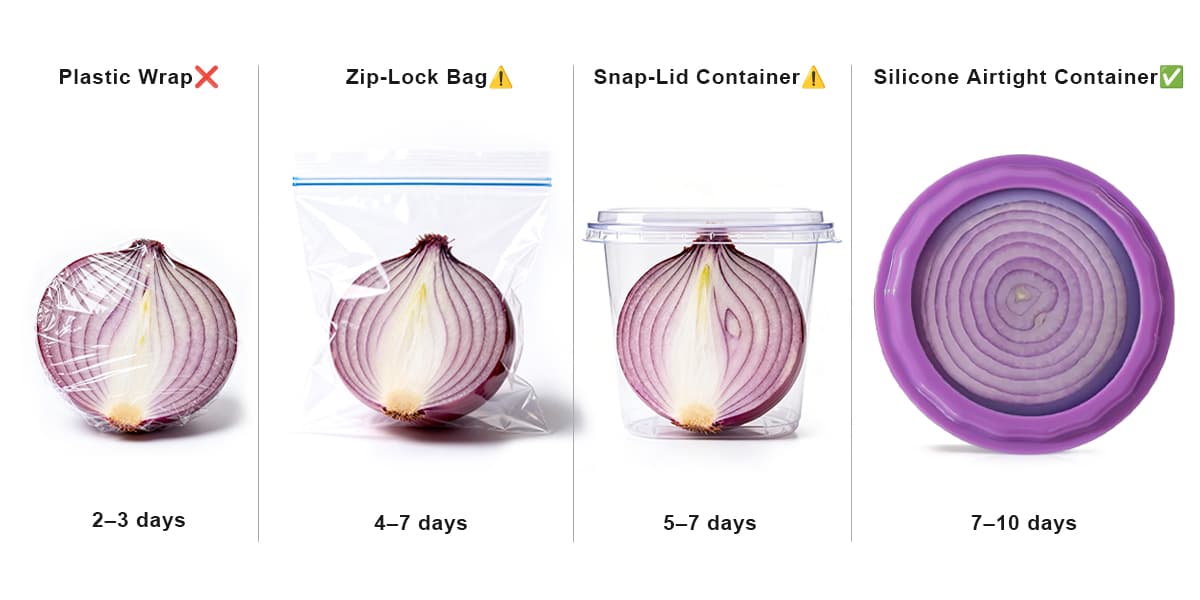
| Storage Method | Shelf Life | Odor Control | Verdict |
|---|---|---|---|
| Plastic wrap | 2–3 days | ❌ Poor | Last resort only |
| Zip-lock bag | 4–7 days | ⚠️ Moderate | Decent for diced, short-term |
| Hard container, snap lid | 5–7 days | ⚠️ Moderate | Good, not fully sealed |
| Airtight silicone container | 7–10 days | ✅ Zero transfer | Best option |
How Long Does a Cut Onion Last? (By Cut Type)
At room temperature, a cut onion lasts no more than 2 hours safely. In the fridge, properly sealed, up to 10 days.
Shelf life varies depending on how the onion was cut. More surface area means more sulfur exposure and faster deterioration.
Half onion (cut straight across)
The smallest cut surface, so it lasts longest. Stored cut-side down in an airtight container: 7 to 10 days. In a zip-lock bag: 5 to 7 days. In plastic wrap: 2 to 3 days before the surface toughens.If you're storing a half onion specifically, we tested four methods in detail — see how to store half an onion.
Sliced onion (rings or half-rings)
More surface area than a half onion, so it breaks down a bit faster. Airtight container: 5 to 7 days. Zip-lock: 3 to 5 days. Plastic wrap: 1 to 2 days maximum.
Diced onion
Maximum surface area, fastest deterioration. Airtight container with a paper towel layer to absorb moisture: 5 to 7 days. Zip-lock: 3 to 5 days. Exposed: don't bother past 24 hours.
Cooked onion (caramelized, sautéed, etc.)
Surprisingly, cooked onion lasts longer than raw once it's in the fridge. The cooking process breaks down the allicin and kills surface bacteria. Airtight container: 5 to 7 days, sometimes up to 10 if it was cooked thoroughly and cooled quickly before refrigerating.
The Right Way to Store a Cut Onion (Step by Step)
The method below applies to any cut type. The principles are the same whether you're dealing with a half onion or a bowl of diced onion.
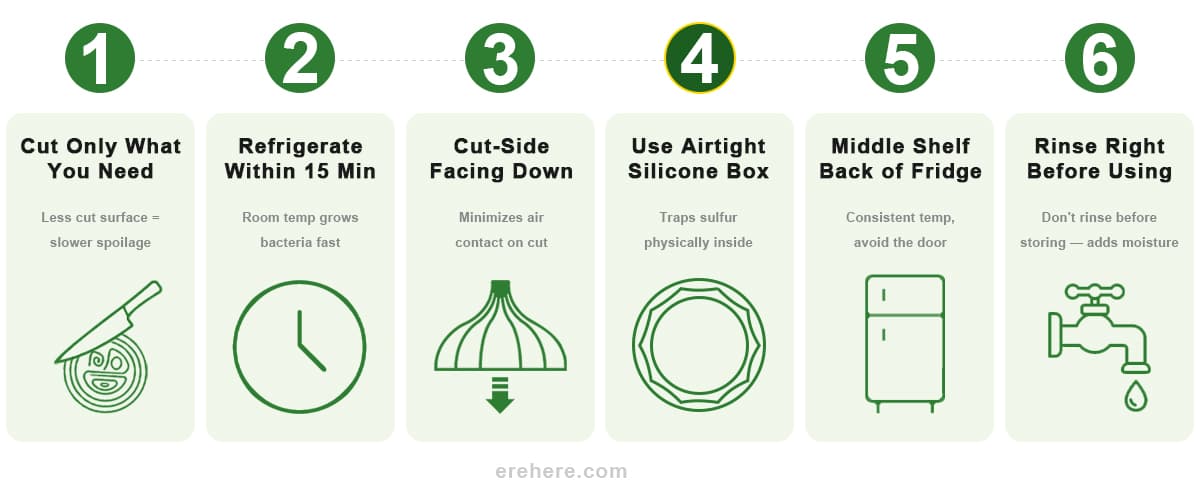
- Cut only what you need. Every additional cut increases surface area and accelerates sulfur release. Cut the minimum amount required for your recipe.
- Refrigerate within 15 minutes. Room temperature accelerates bacterial growth on exposed onion surfaces. The USDA recommends refrigerating cut produce promptly — for onions, the sooner the better.
- Store cut-side down. For a half onion, press the flat cut surface against the silicone seal or the bottom of the container. This minimizes the surface area in contact with air inside the container.
- Use an airtight silicone container. For a dedicated onion keeper, use one shaped to fit a half onion snugly. The less empty space inside the container, the less air — and the less oxidation.
- Keep toward the back of the fridge. Temperature at the back of the fridge is more consistent than near the door. The National Onion Association recommends 40°F (4°C) or below for cut onions.
- Don't rinse until you're ready to use. Adding water to a stored onion accelerates the alliinase reaction that creates sulfur compounds. Rinse right before use, not before storing.
Can You Store a Cut Onion in the Freezer?
Yes — and freezing is genuinely useful if you cut more onion than you'll use within a week, or if you want to do meal prep in advance.
The important thing to understand is that freezing changes the onion's texture. Ice crystals form inside the cells and rupture the same cell walls that give raw onion its crunch. A frozen and thawed onion will be soft and slightly watery — perfectly fine for soups, stews, braises, stir-fries, and anything cooked. Not ideal for salads, garnishes, or dishes where you want raw onion's crunch and bite.
To freeze cut onion properly:
- Dice or slice the onion as you normally would.
- Spread pieces in a single layer on a parchment-lined baking sheet.
- Freeze for 1 to 2 hours until the pieces are individually solid.
- Transfer to a freezer-safe zip-lock bag, squeeze out as much air as possible, and seal.
- Label with the date. Use within 3 to 6 months for best flavor.
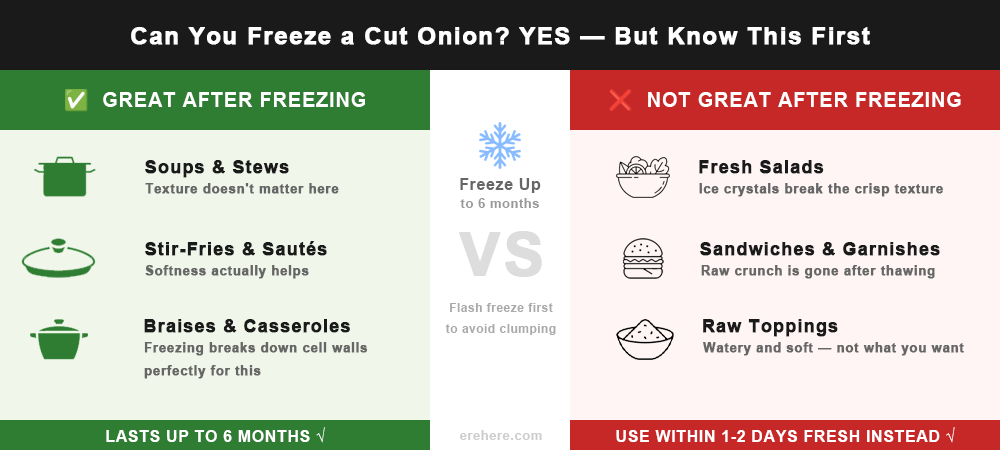
The pre-freeze step (flash-freezing on a baking sheet before bagging) prevents the pieces from clumping together into a solid block, which makes it impossible to scoop out just the amount you need later.
Is It Safe to Store a Cut Onion in the Fridge?
Yes, completely. This is worth addressing directly because an old claim circulates periodically that stored cut onions become toxic or dangerous — usually attributed to some unnamed "study" or health authority.
There is no credible scientific or food safety basis for this. The National Onion Association states clearly that cut onions stored in a sealed container at 40°F or below are safe for 7 to 10 days, consistent with USDA food safety guidance. Properly refrigerated cut onion does not become a bacteriological hazard.
The confusion likely stems from the fact that cut onion left at room temperature does support bacterial growth — as does any cut vegetable. The solution isn't to avoid storing cut onion. It's to refrigerate it promptly and use an airtight container.
How to Tell When a Cut Onion Has Gone Bad
A cut onion that has been stored correctly will tell you when it's past its useful life. Look for:
- Slimy or slippery texture. Fresh cut onion is firm and slightly dry on the surface. Sliminess means bacterial activity has started.
- Discoloration. Brown or gray patches on the cut surface, or darkening throughout. Minor surface browning on a half onion can sometimes be sliced off to reveal fresh onion underneath, but widespread discoloration means it's done.
- Unusual smell. Fresh cut onion smells sharp and sulfurous in a clean way. A sour, fermented, or rotten smell means it has turned.
- Soft or mushy spots. Fresh onion is firm throughout. Any soft areas indicate breakdown.
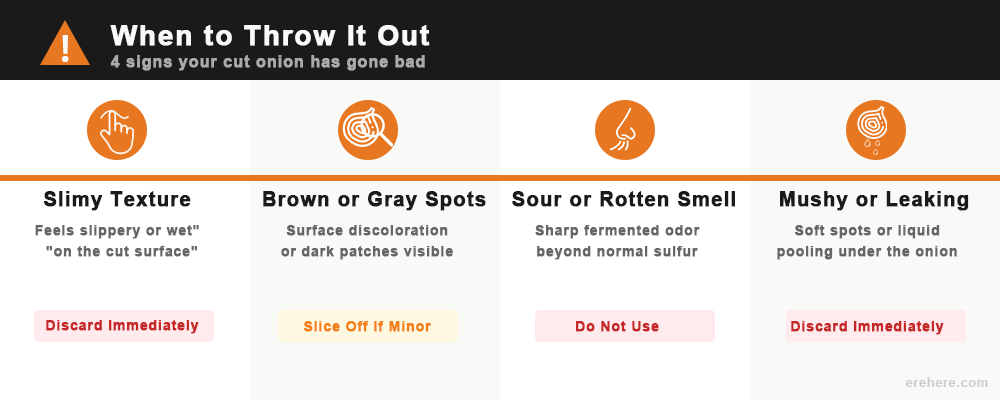
When in doubt, throw it out. An onion that was $1.50 at the grocery store isn't worth a second thought.
The Problem With Every Other Food in Your Fridge
One thing most onion storage guides skip over: it's not just the onion that suffers when storage fails. Sulfur compounds from a poorly stored onion will absorb into butter, soft cheeses, leftover rice, cooked proteins, and any other porous food nearby. You've probably experienced this — food that tastes faintly of onion even though you stored it separately.
This is the actual reason an airtight seal matters. It's not just about the onion's shelf life. It's about keeping everything else in your fridge tasting like itself.
If you cook with onion regularly — meaning you often have a cut half sitting in your fridge — a dedicated airtight produce keeper set that includes an onion container makes the most practical sense. The silicone seal traps the sulfur inside the container where it belongs, and the rest of your fridge stays neutral.
Frequently Asked Questions
How long does a cut onion last in the fridge?
A half onion stored cut-side down in an airtight container lasts 7 to 10 days in the fridge. Diced or sliced onion has more surface area and lasts 5 to 7 days under the same conditions. In plastic wrap, expect 2 to 3 days before texture and flavor deteriorate.For a full breakdown by storage method, see our guide on how to store half an onion.
Why does my fridge smell like onion even when the onion is wrapped?
Sulfur compounds released from cut onion are small enough to pass through plastic wrap and zip-lock bag seals. They off-gas continuously from the cut surface and absorb into other foods nearby. Only a silicone airtight seal physically traps them inside the container.
Can I store a cut onion in water?
No. Research from America's Test Kitchen found that water actually accelerates the alliinase reaction that produces sulfur compounds, making onions stored in water more pungent and sharp-flavored than those stored in a zip-lock bag. It also creates favorable conditions for bacterial growth.
Should I store cut onion cut-side up or cut-side down?
Cut-side down, pressed against the container bottom or silicone seal. This minimizes the surface area in contact with the air inside the container, slowing oxidation and reducing sulfur off-gassing.
Can cut onion make other food taste like onion?
Yes. Sulfur compounds from a poorly sealed cut onion absorb into butter, cheese, cooked leftovers, and other porous foods stored nearby. An airtight container prevents this completely.
Is it safe to eat a cut onion that's been in the fridge for a week?
If it was stored in an airtight container at 40°F or below and shows no signs of sliminess, discoloration, or off-smells, yes. The National Onion Association cites USDA guidance that properly stored cut onion is safe for 7 to 10 days.
Can you freeze a cut onion?
Yes. Flash-freeze diced or sliced onion on a baking sheet first, then transfer to a zip-lock bag with the air squeezed out. Frozen onion keeps for 3 to 6 months and works well in cooked dishes, though the texture after thawing is too soft for raw applications like salads.

